Green T&T in collaboration with the Tobago Tourism Agency Limited (TTAL) hosted the prestigious Blue Flag National Operators Meeting (NOM) 15-18 October 2024, bringing together environmental leaders, policymakers, and stakeholders committed to the sustainability of our coastal areas. This landmark event highlighted key discussions on marine conservation, responsible tourism, and the role of certification programs in preserving the beauty of our beaches and marinas.
A component of the Blue Flag NOM that was funded by the GEF Small Grants Programme (SGP) UNDP Trinidad and Tobago, provided a platform for knowledge sharing and strategic planning towards achieving Blue Flag Certification—a globally recognised eco-label that promotes environmental responsibility and sustainable tourism.
One of the key outcomes of the event was the development of a Sustainable Blue Economy Policy, designed to guide both local and international Boat Tour Operators in promoting marine conservation and responsible practices. This policy serves as a roadmap for sustainable development while ensuring the protection of vital coastal and marine resources.
With expert presentations, insightful panel discussions, and action-driven workshops, the event reinforced the importance of collective responsibility in preserving our marine and coastal ecosystems.
In Tobago, two accommodations, Castara Retreats and Hibiscus Heights, have recently been added to the list of internationally certified Green Key hotels, bringing the total number of certified properties on the island to seven. Adventure Eco Villas, Bananaquit Vacations, House of Grace, Tropical Apartments, and Shepherds Inn in Tobago have received Green Key certification. In addition, Native Abode has recently embarked on a remarkable accomplishment by receiving its second certification. Additionally, once again, Miss Ayana and Top Catch Charters, the Tobago boat operators, have been awarded Blue Flag certification. Top Catch Charters has maintained this certification for three consecutive years, while Miss Ayana has achieved it for the second time. These two operators have consistently showcased their commitment to environmental responsibility and sustainable operations.
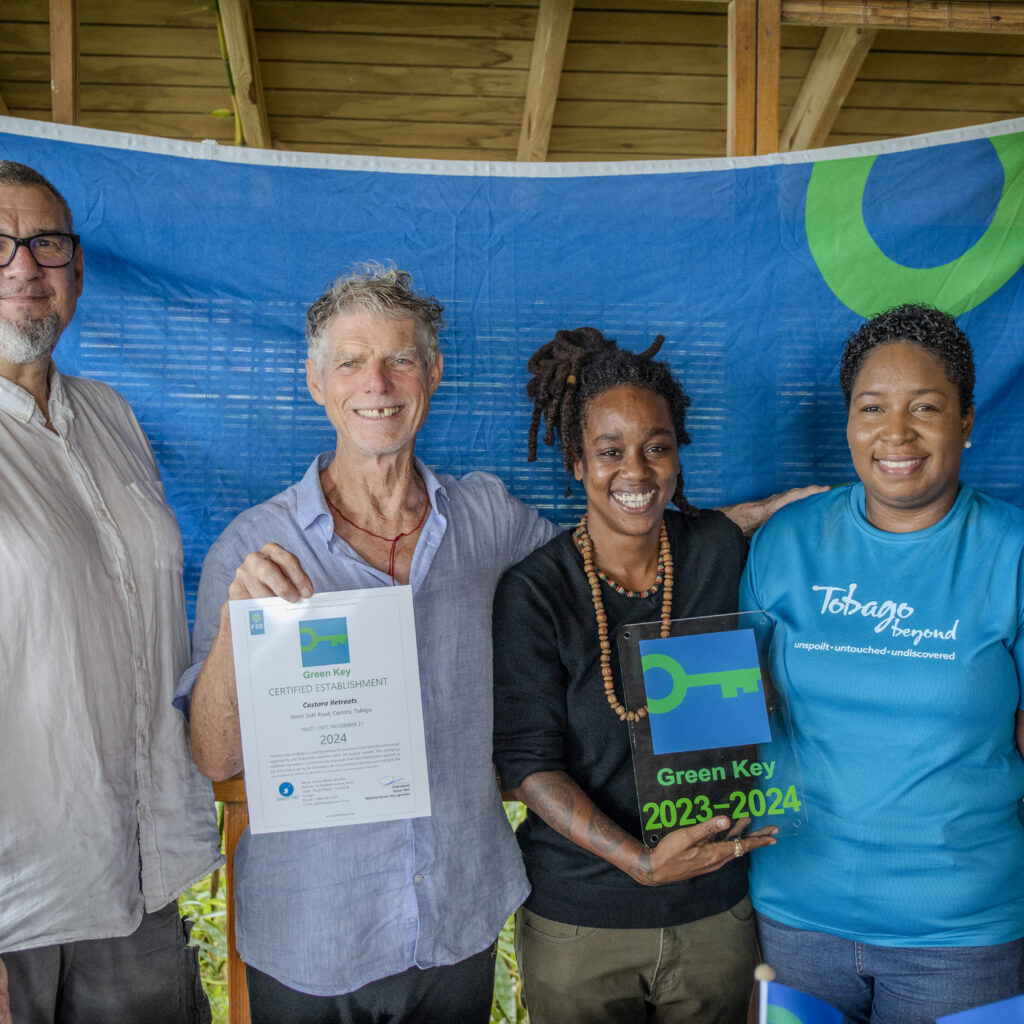
Above: First-time certified Castara Retreats receiving their plaque and certification from members of Green T&T and TTAL
National Operator Green T&T currently implements the Green Key and Blue Flag programmes in partnership with the Tobago Tourism Agency Limited (TTAL), both of which have been instrumental in promoting environmental responsibility and sustainable operation within the tourism and hospitality industry.
Coordinated by the Foundation for Environmental Education (FEE), Green Key and Blue Flag are two of the most globally recognised voluntary eco-certification programmes. The certification process evaluates various aspects of an establishment’s operations, including environmental management, waste management, environmental education and other sustainable practices, with over 4,400 certified Green Key sites and over 5,080 Blue Flag sites in more than 50 countries worldwide.
The recent certification ceremony occurred on November 21st and 22nd, where hotels and boat operators received their well-deserved Green Key and Blue Flag certificates and plaques and flags that proudly display their commitment to sustainable practices. This celebration marks a significant milestone for Tobago tourism as it prioritises eco-friendly initiatives that benefit visitors and the local environment.
Since 2018, TTAL has invited all tourist sites, accommodations, attractions, and restaurants in Tobago to participate in the programme. Participating sites can receive a comprehensive assessment from Green T&T and work towards meeting the esteemed Green Key standards. The sites are audited, and the respective National Juries review their applications. Upon achieving full compliance, these sites are awarded Green Key or Blue Flag certification for one year. This rigorous process has established Green Key and Blue Flag as some of the most reputable eco-labels worldwide, trusted by prominent chains such as Radisson, Marriott, Accor, and Hyatt.
The Tobago Tourism Agency Limited (TTAL) has issued this statement:
With seven (7) Green Key-certified properties, there are now more accommodationoptions for the eco-conscious visitor to Tobago. This sets Tobago apart from othercountries in the English-speaking Caribbean. The Tobago Tourism Agency Limited (TTAL)is committed to promoting the Green Key programme to increase theawareness and adoption of the sustainable practices inherent in the certification.Together with programs such as the Tobago Recycling Resource Initiative andlegislation such as the Waste Management Rules, 2021 and the Wate ManagementRegulations, 2021, which lay out guidelines for reducing waste generation andexercising environmentally sound management of waste, Tobago is on the way tobeing more widely known as a destination where sustainable environmentalmeasures are commonplace.For Blue Flag, the awards signal the continued ability of the two boat operators to maintain the standards set out by Blue Flag. They act as a draw to the destination for travellers seeking to reduce their carbon footprint while resident and as an example to other boat operators locally and within the region. The Tobago Tourism Agency Limited (TTAL) will continue to promote the Blue Flag program among boat operators and pursue full Blue Flag status for the pilot beaches at Mt. Irvine, Bloody Bay and Kings Bay.”
For Castara Retreats, the journey to certification was most impactful, with their sustainable approach supported by staff members and the community. The owner of Castara Retreats, Steve Felgate, cited:
“Green Key as an excellent validation of priorities that we have been long-term committed to at Castara Retreats. We plan to continue setting and achieving targets year after year and for our passion to protect and enhance the environment to be shared by guests, staff and all our local and international partners. We are super excited to share this journey with others. Our strategy for sustainability, to be published in early 2024, is now our top business priority.”
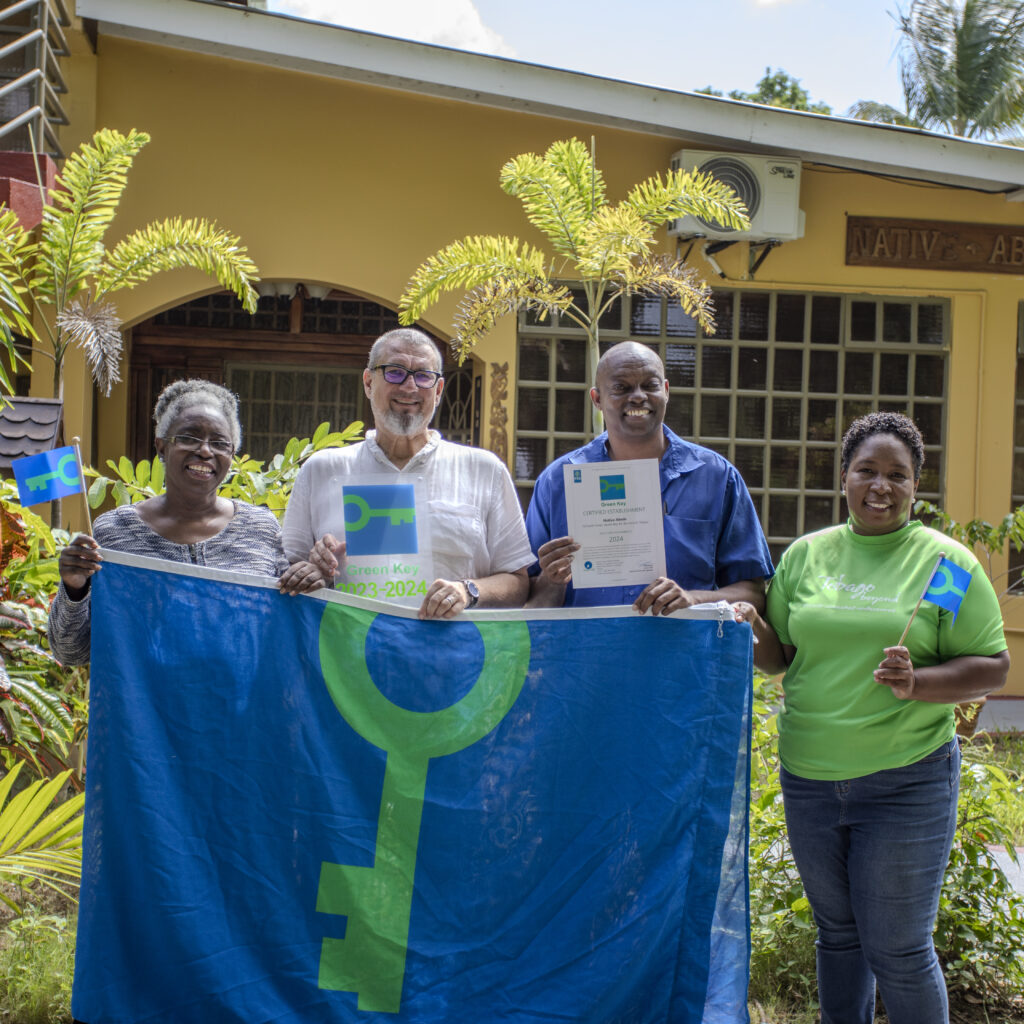
Native Abode is well-acquainted with the process and remains enthusiastic about the program. Here’s what they had to say:
“We have always strived to use our comparative advantage to make current and future gains in our business. This includes producing fruits and vegetables in an organic way, practising energy and water conservation, pre-ordering breakfast to reduce wastage, and using appropriate technology to eliminate printing. Green Key has provided formal recognition of how we do business. So, being Green Key certified means how we do business protects the environment and promotes sustainable prosperity, which resonates well with the growing climate-conscious market.“
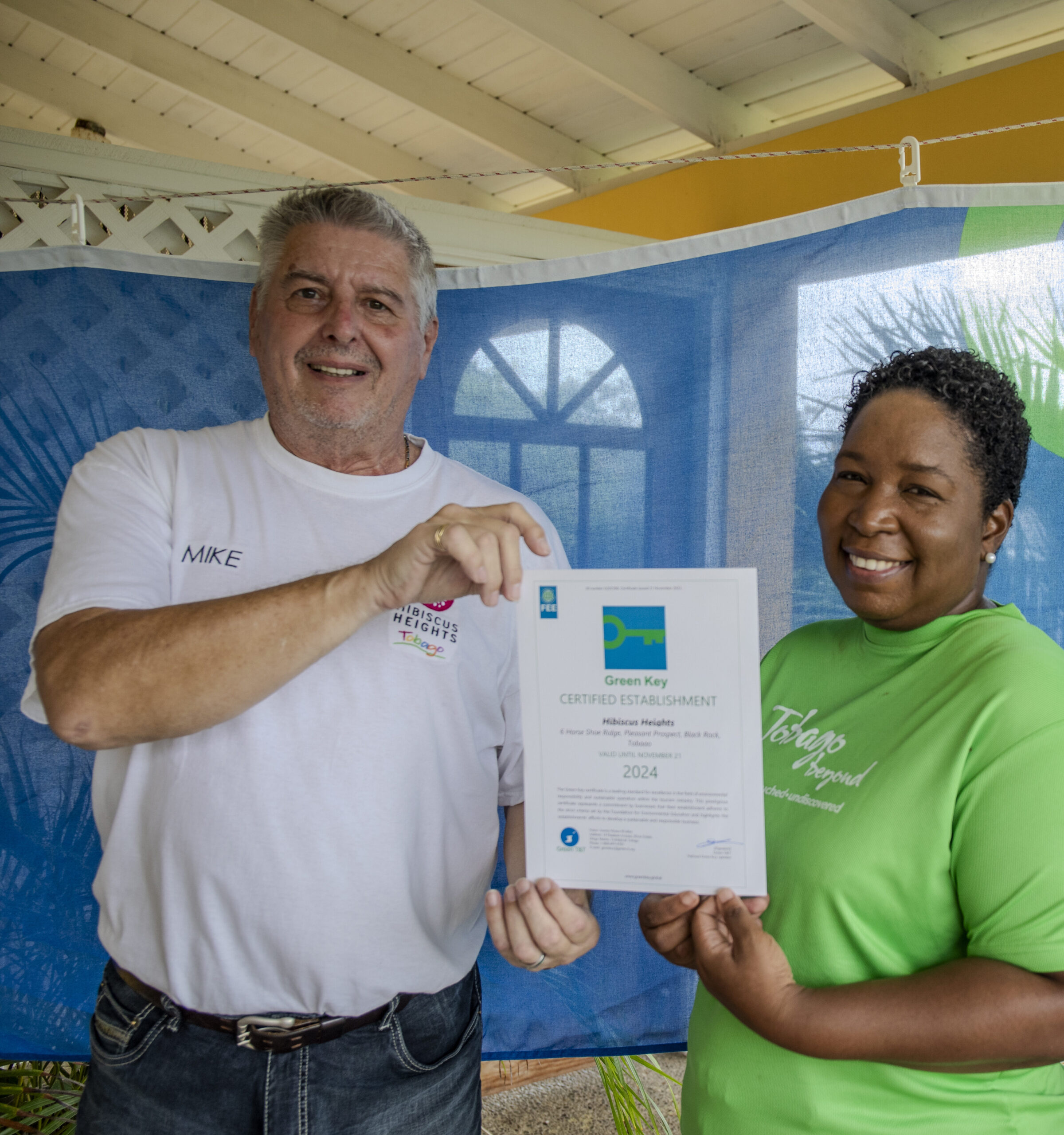
Second-time awarded Native Abode celebrating with members of Green T&T and TTALOwner Mike Walmsley of the newly certified Hibiscus Heights receiving his certificate from Kirsten Cowie-Irvine of the Tobago Tourism Agency Limited (TTAL)
Hibiscus Heights is a small but ambitious accommodation provider that has surpassed many criteria and eagerly anticipates reaping the rewards of its efforts. Owner and Manager of Hibiscus Heights, Mike Walmsley, said:
“Technology can offer excellent advantages and help reduce our carbon footprint; as an example, we installed wifi controlled remotes for all our air-conditioning units; this enables us to turn off the units when guests forget and leave on for the day, without having to go into the apartments. We can also reset the temperature any time from an app on the phone, even if we are not on the premises. The savings are a win-win.“
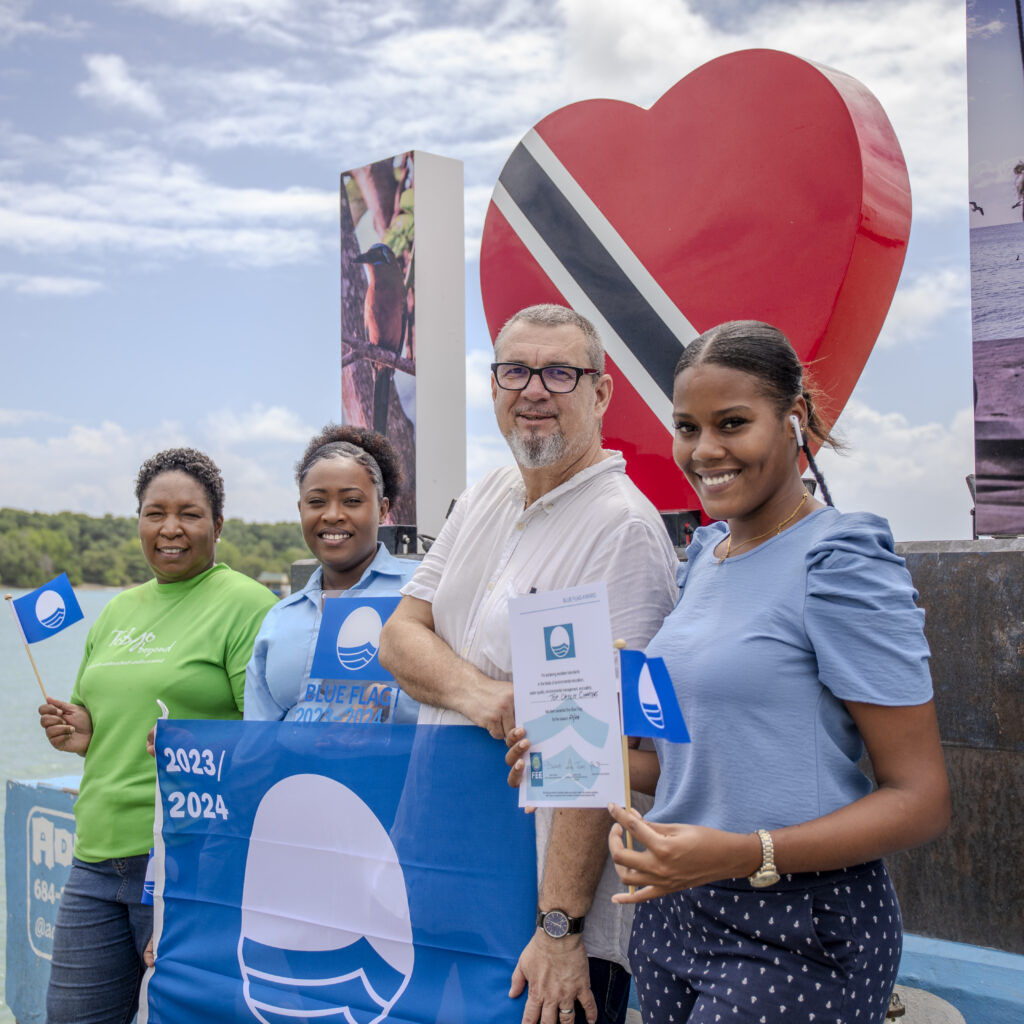
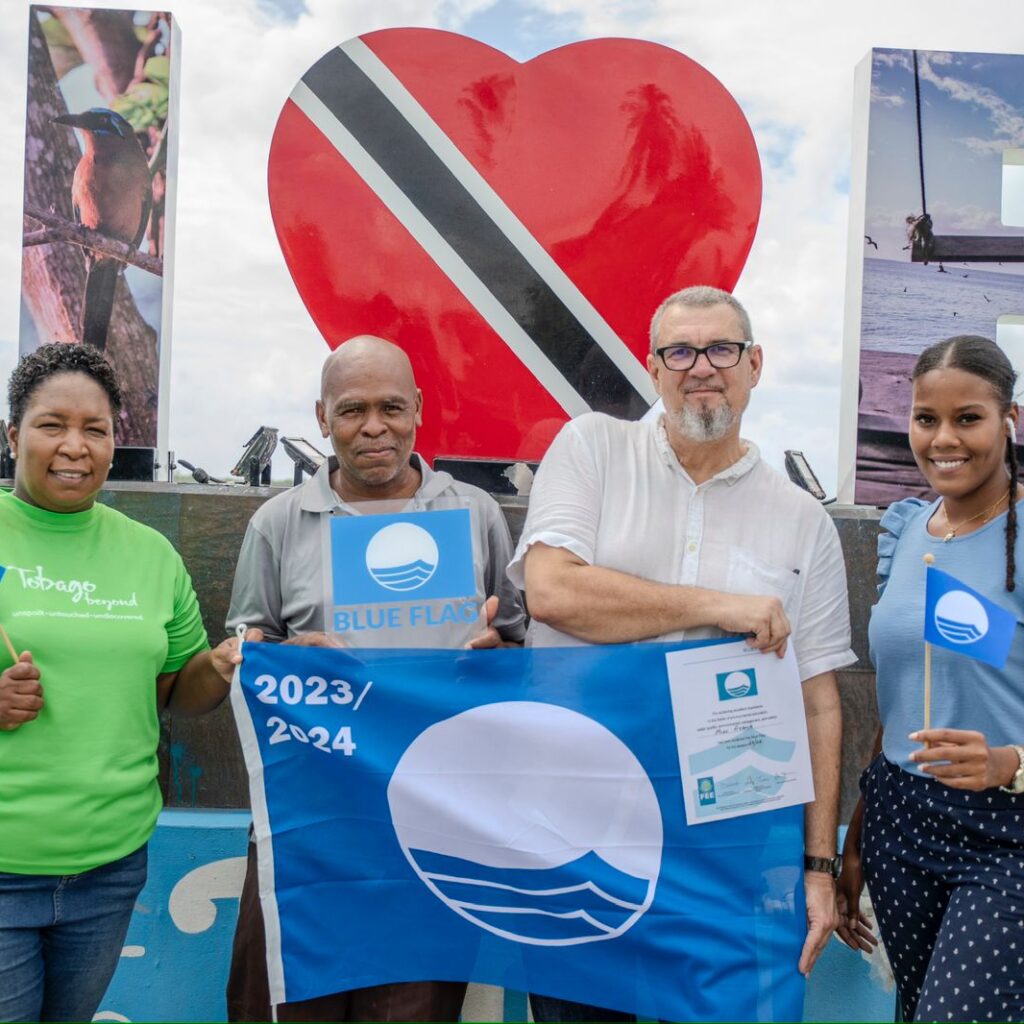
Jenna Reid of Top Catch Charters receives the 2023-2024 Blue Flag award with members from the Tobago Tourism Agency and Green T&TBoat Owner Dexter Black receives his Blue Flag plaque for the 2023-2024 season
Top Catch Charters boat operator Shivonne Peters and her team have been in the programme since 2021 and have this to say about their continued involvement and benefits derived:
“we have seen sustained and continued benefits from the Blue Flag programme in terms of the efficiency of our operations, our safety practices and in promoting sustainable practices for our guests and in our community. Our customer base continues to widen as more visitors seek sustainable tourism activities. Through the programme, we have been able to conduct environmental projects and collaborate with stakeholders to conserve Tobago’s marine environment”.
Second-time certified Miss Ayana Glass Bottom Boat operated by Dexter Black said:
“The management and crew of Miss Ayana are delighted to have our blue flag certification renewed for the year 2023/2024. We are excited and willing to operate in a sustainable and eco-friendly environment. The blue economy is vital for us as an island and nation, and we must preserve it for generations to come.”
As the National Operator for this programme in Trinidad and Tobago, Green T&T continues to collaborate with hospitality and tourism establishments across both islands to recognise and commemorate their existing sustainable initiatives through participation in the esteemed Green Key and Blue Glag programmes. CEO of Green T&T, Joanna Moses-Wothke, cited:
“Green T&T, as the National Operator for the programme in Trinidad and Tobago, actively seeks partnerships with beach management, boat operators, tourism, and hospitality properties across the Caribbean. We aim to identify and promote sustainable practices by participating in esteemed programmes such as Blue Flag and Green Key. Through collaborative efforts, we aspire to elevate the industry’s dedication to environmental stewardship and responsible tourism.”
With financial assistance from the UNDP GEF SPG Trinidad and Tobago Green Innovator Challenge https://www.facebook.com/GEFSGPTT, three tour boat operators in Tobago received the internationally recognised Blue Flag award.
The Blue Flag certification for beaches, boats, and marinas https://www.blueflag.global/ is a highly valuable branding and marketing tool for eco-friendly services and speaks specifically to the European tourism source markets. This programme has been operating in Europe since 1987 working to bring together the tourism and environmental sectors at local, regional and national levels to ensure sustainable tourism. It is managed by the Foundation for Environmental Education https://www.fee.global. Currently, the Blue Flag is flying at over 4,800 sites in 50 countries and has over 80 Blue Flag-awarded boat operators worldwide
The certification process in Tobago was facilitated by Green T&T https://green-tt.org, the National Operator for the Blue Flag programme and endorsed by the Tobago Tourism Agency Ltd, Tobago’s Destination Management Organisation https://www.visittobago.gov.tt.
Joanna Moses-Wothke, CEO of Green T&T further elaborates:
“This major achievement means the boat operators understood and complied with strict international standards pertaining to environmental management, environmental education and information, safety and services, as well as social responsibility; they are now ready to reap the marketing and sales benefits of this prestigious award.”
The Tobago boat operators were trained by Green T&T to reduce their environmental footprint, improve their environmental interpretation skills, and use Blue Flag as a post-COVID recovery tool to meet Blue Flag’s stringent performance criteria.
Ms Shivonne Peters, Manager of Top Catch Charters explains the significance of recertification of the Blue Flag award:
“Our second Blue Flag award is especially thrilling for us at Top Catch Charters. For the second year, we have fulfilled our goal of providing eco-friendly tours and reducing our environmental impact. It’s not just about Top Catch Charters but also about the transformation of Tobago’s tourism industry. Sustainable tourism is possible and Top Catch Charters intends to continue this drive and provide the highest standard possible, not only with respect to our environmental regulations but also our guest experience.”
Dr Sharda Mahabir, National Coordinator GEF SGP UNDP, also extended her congratulations and expectations:
“GEF SGP is pleased to support Green T&T in their efforts to strengthen tourism by certifying boat operators under Blue Flag. This certification will put our beautiful sister isle on the map in terms of initiatives in support of the Blue Economy. We look forward to positive outcomes and benefits coming out of this project and more GEF SGP projects on the sister isle.”
Trinidad and Tobago is making its mark and championing the cause for real change regarding sustainable tourism, post Covid-recovery, and climate change resilience.
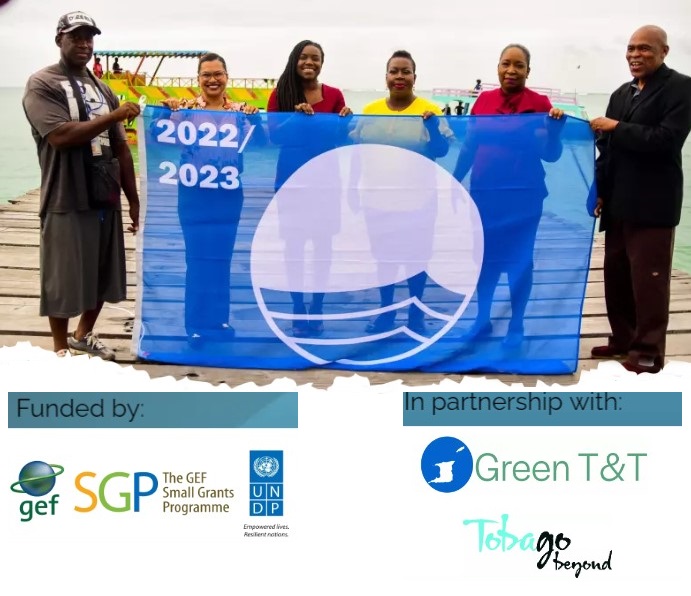
(Left to right) Blue Flag awardee Mr. Ronnie Elliott, Mrs. Michelle Lewis, Secretary Tashia Burris, TTAL Board Director Ms. Avion Hercules, Mrs. Kirsten Cowie-Irvine, and Blue Flag awardee Mr. Dexter Black with the Blue Flag on Pigeon Point Jetty. [Photo courtesy Division of Tourism, Culture, Antiquities & Transportation]
Two Buccoo Reef tour boats- Miss Ayana and Cool Runnings, have been granted the Blue Flag award for the first time Top Catch Charters of Buccoo, Tobago was also recertified for the 2022- 2023 Blue Flag season.
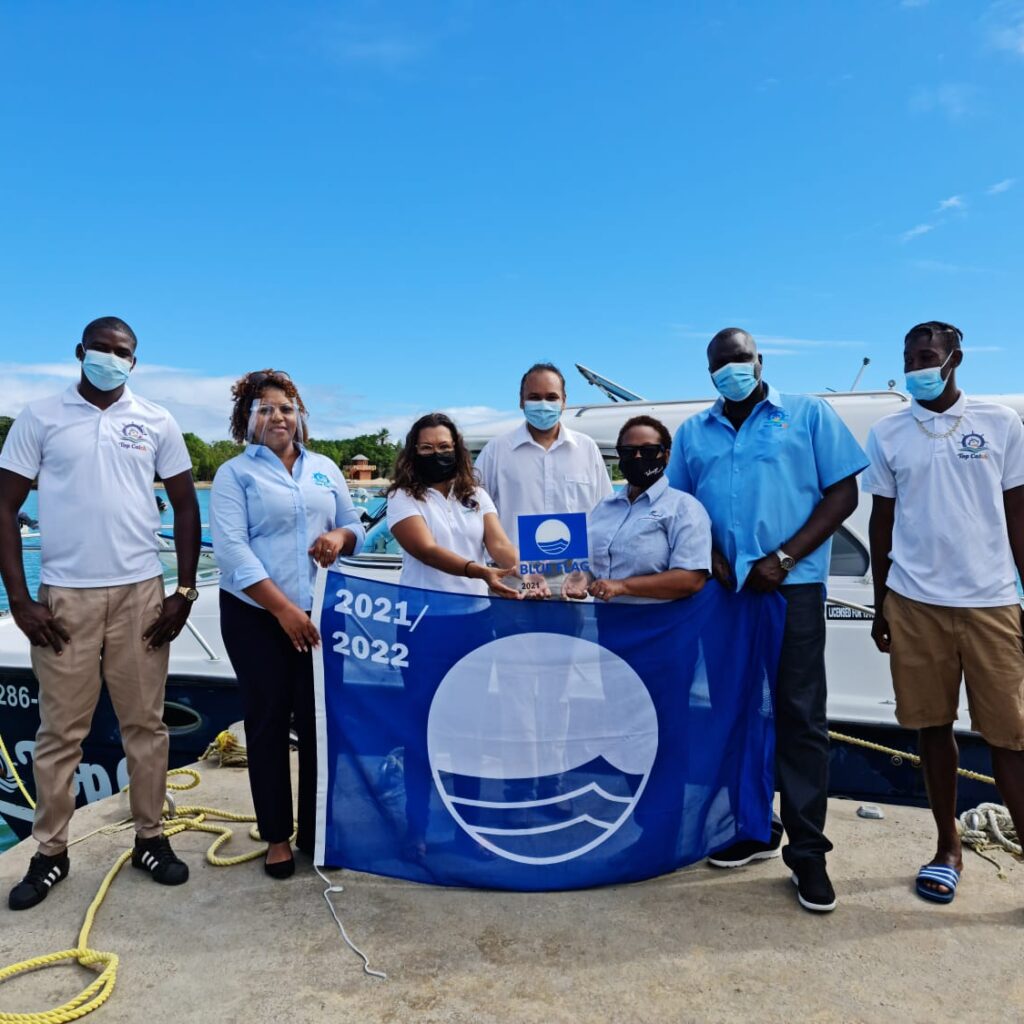
History was created in Tobago on Friday when boat operator Top Catch Charters was acknowledged for receiving the prestigious Blue Flag award in 2021.
Top Catch Charters is the first boat operator in the entire English-speaking Caribbean to receive the award.
Blue Flag is an eco-label with high brand recognition in the international tourism market. It is also one of the world’s most recognised voluntary eco-labels awarded to beaches, marinas, and sustainable boat operators.
The programme is owned and managed by the international, non-governmental, non-profit organisation, Foundation for Environmental Education (FEE), based in Denmark.
During a simple ceremony on Friday at Merci Buccoo Hall, Buccoo, Top Catch Charters managing director Shivonne Peters said when her team got the opportunity to expand their operations, they wanted to be different.
“We didn’t want to be the typical run-of-the-mill service. We wanted to really extend that passion that we have. We have a serious passion and commitment for Tobago’s natural environment,” she said.
Peters said she and fellow boat owner Kirth Mc Pherson have been involved in environmental sustainability for many years.
Saying Mc Pherson’s family was among the first tour operators on the island, Peters said as a marine scientist, she constantly researches the marine environment.
“So, we really wanted to have our guests experience sustainability when they come on board the vessel. We didn’t just want it to be an on-the-vessel experience. We wanted it to extend beyond the life of a tour.
“So, we would give out reusable bamboo straws as sort of a keepsake – something that they could really use to make your actions sustainable in the long term.”
Peters said the Blue Flag award to Top Catch Charters is the “realisation of a dream of things we have been doing from day one.”
She encouraged all of the other boat operators in Tobago to get on board.
“This has to be collective effort moving forward. We have so much to be thankful for in Tobago. We have so much natural beauty around us but each of us has to play our part in protecting that beautiful marine environment.”
Peters said the Blue Flag award is not just a win for Top Catch Charters but Tobago.
Narendra Ramgoolam, director, product development and destination management, Tobago Tourism Agency Ltd (TTAL) said Top Catch Charters met the Blue Flag criteria even before signing on the programme.
“When we started looking at the audit process…we looked through the documents and Top Catch was checking off all of those areas without even applying for Blue Flag,” he said.
“They were fulfilling the first aid requirement, the safety practices, the equipment, they had recycling in their boat. But what impressed me as well were the bamboo plates, the cutlery. So, they were already operating in an environmental manner without even applying for Blue Flag.”
Ramgoolam described the award as a huge achievement.
“It is the first in the region. But it is also the first public-private partnership to achieve Blue Flag in the region as well. So that is a huge accomplishment as well.”
He said the award also balances recreation and conservation.
“It is a win-win on both sides.”
Ramgoolam said he hopes the award will be a catalyst so that others will come on board “so we will work together to build out the products in Tobago and align it with our brand, our image, our identity.”
TTAL CEO Louis Lewis and Programme Co-ordinator Green TT Michelle Lewis also spoke.
Is the beach just a popular pastime or a cure for anything that may ail you? Your grandparents may wholeheartedly declare that a dip in the sea is the best way to conquer any cold or complaint. But what if, the water is the source of it?
On the surface, we are surrounded by beautiful and pristine beaches but when the UNEP revealed that 85% of wastewater entering the Caribbean Sea is not adequately treated you are compelled to take a closer look. Just under 50 years ago many countries believed that it was acceptable to liberally dump garbage and sewage into the oceans. With only 20% of the ocean mapped and explored it’s easy to understand why persons thought that the effects would be negligible or too minimal to matter. This meant that wastewater lines from domestic and industrial areas led directly to the sea. And travelling with it were a variety of toxins and pathogens.
While wastewater is made up of mostly water, it also contains sewage, which is generally described as water contaminated with faeces and/or urine. Untreated sewage carries with it a host of viruses, bacteria, and parasites to name a few. Swimming, bathing, or eating seafood from contaminated water sources can directly impact human health. Diarrhoea, cholera, and hepatitis are some of diseases and illnesses you can contract when infected. To determine whether beaches are safe to swim in it or if it is free from contaminated effluents, it is an accepted practice that you measure the levels of Escherichia coli (E coli) and Enterococci, two forms of bacteria commonly found in faecal matter[i].
In response to the need to ensure safe bathing water quality the international Blue Flag standard requires every beach operator to conduct these tests monthly and post the values on its public information board. This allows beach users to make informed decisions on whether the recreational water quality is acceptable, but it also keeps the public informed of any changes. It can be a rigorous standard to comply with, but it is a necessary mandate to ensure the safety of all beach goers.
In the absence of this information these are some key guidelines you can adhere to:
Do not bathe near river mouths especially after heavy rainfall, with increased surface runoff and trash from land the risk of infection is higher
Avoid stagnant, murky or poor smelling water
Do no enter water with dead or sick animals nearby
If you are vomiting, have diarrhoea or any other gastroenteritis-like symptoms you should not enter the water to prevent others from getting sick as well.
If you suspect that water is contaminated contact the Water and Sewage Authority (WASA) or the relevant Regional Corporation in that district.
Take a short stroll on a beach or along a river- bed and you will easily find plastic bottles, wrappers, and bags. However, plastic is just one type of pollutant. Our oceans are a liberal dumping ground for garbage, sewage, and chemicals and it has become alarmingly clear that pollutants directly impact our health.
PLASTIC POLLUTION
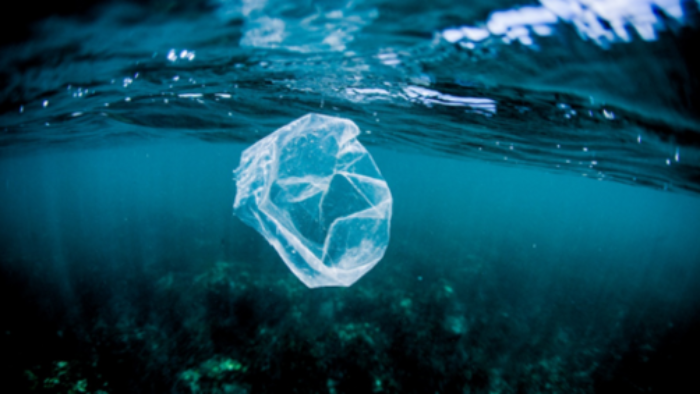
Numerous studies highlight the impact of plastic on the marine environment. One dizzying estimation is the projection that there would be more plastic than fish by the year 2050. Over one hundred and fourteen species have been found to contain microplastics, half of these we consume. This means that toxins are entering our food chain in ever increasing numbers.
BLUE FLAG vs PLASTIC
How can Blue Flag help? While dire, the impact of plastic pollution can be changed, restricted and hopefully one day completely reversed. Countries can implement and enforce laws, create policies, and impose new controls to deter pollutants from entering the ocean. While commendable it is a lengthy process involving a myriad of stakeholders.
Blue Flag certification reduces this timeline by immediately addressing some of the key concerns of plastic pollution. As part of its environmental management plan, it enables and instructs the operator and user to actively recycle plastic waste. It encourages a complete ban of single use plastics on its site and continuously monitors the degree of pollution at key source points.
As we all may know human activity is the primary cause of plastic pollution meaning that human action can prevent it. The Blue Flag standard assures the beach user that their actions can have a positive impact on the environment.
What can you do to safeguard our fragile ecosystem?
You can place your recyclables in the right bin.
Do not use single use plastics instead opt to bring your own or ensure that all disposables are made from compostable material.
And remember, you are safer at the Blue Flag Beach!
On Monday 12th October 2020, the Tobago Tourism Agency Limited (TTAL) received Blue Flag Pilot status approval from the Blue Flag International Jury for three Tobago beaches. King’s Bay, Bloody Bay and Mt Irvine Bay got formal endorsement to fully engage in meeting the Blue Flag standards and submit applications for Blue Flag Certification as early as 2021. This makes Tobago the only island in the Lesser Antilles with Blue Flag approval to the benefit of visitors and residents alike. Blue Flag is one of the programmes implemented in Trinidad and Tobago by the NGO Green T&T.
The Blue Flag Programme, with over 4,660 Blue Flag sites in 47 counties, is the world’s most recognised voluntary eco-label with the highest brand recognition in the international tourism market regarding clean, safe, environmentally responsible beaches, marinas and sustainable boat tour operators (also known as sites). Blue Flag certification is awarded to sites for their sustainable development efforts achieved through strict criteria relating to water quality, environmental education and information, environmental management, safety and other services. The Blue Flag Programme is one of five programmes of the internationally renowned Foundation for Environmental Education with partners such as the United Nations Environment Programme, the United Nations World Tourism Organisation and the United Nations Educational, Scientific and Cultural Organisation (UNESCO).
The announcement came from the Blue Flag National Coordinator, Joanna Moses-Wothke who provided the details leading up to the announcement and the subsequent steps towards Blue Flag certification.
“Tobago was always poised as an ideal Blue Flag destination, with pristine beaches, an intact montane tropical rainforest and small communities sandwiched between, it was more a matter of time. Any beach that applies for Blue Flag certification must first undergo a gap analysis against the Blue Flag standards and must submit measures towards compliance. The gap analyses along with the recommendations to meet compliance were submitted first to the Blue Flag National Jury in June this year and forwarded to the International Blue Flag Jury the following month for the final pilot status approval. Once the pilot beaches are in full compliance, TTAL can submit the beach applications to the National and International Blue Flag Juries for the official Blue Flag award as early as 2021” Joanna Moses-Wothke explained.
Besides the Blue Flag requirements, the three beaches share unique ecosystems such as coral reefs and rivers with rich biodiversity. Additionally, King’s Bay and Bloody Bay are situated in the planned North East Tobago UNESCO Man-and the-Biosphere site, another credence of international significance that promotes blue and green economies and sustainable management of natural resources.
Narendra Ramgulam, Director Tourism Product Development & Destination Management at the Tobago Tourism Agency Limited stated:
“Blue Flag is one of the world’s most reputable and recognized awards for beaches. Having been awarded pilot status for 3 beaches means that we are taking steps in the right direction to not only boost our environmental sustainability as a destination but we are in the process also leveraging and building confidence in our eco-conscious travellers. Trends from leading tourism journals and studies indicate that travellers post covid-19 are going to be demanding safe destinations and destinations that are perceived to be clean/green. In this regard, Blue Flag gives destination Tobago an edge over our competitors, and no other beaches in the English-Speaking Caribbean are Blue Flag certified, so we are definitely first movers in this aspect and hope to continue building on this thrust as we move forward as a destination with the image of being untouched and unspoilt.”
Written by Joanna Moses-Wothke, Blue Flag & LEAF Trinidad and Tobago Asclepius Green
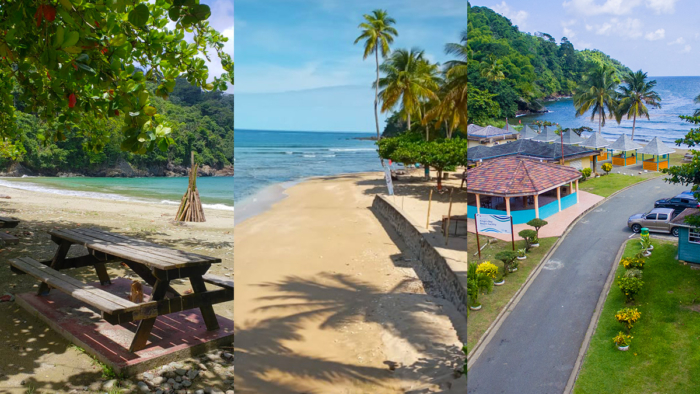
Las Cuevas Beach, located on the North coast of Trinidad, is the only Blue Flag certified beach in the Southern English-speaking Caribbean since January 2015. This means Las Cuevas beach has met internationally recognised standards for safety and environmental awareness and is among 4,000 beaches in over 50 countries that promote good environmental practice identified by the Foundation for Environmental Education (FEE), the Denmark-based non-charitable organization.
Las Cuevas Beach has twice complied with the 33 Blue Flag beach criteria, including monthly water quality testing. The Blue Flag National Coordinator for Trinidad and Tobago, Asclepius Green, continues to work diligently with the Tourism Development Company (the beach operator for Las Cuevas), the Ministry of Tourism and the 12-member National Blue Flag Jury to ensure the beach maintains its acquired status and working on the establishment of other Blue Flag beaches.
Although Blue Flag is synonymous with beach cleanliness and safety, it is recognized as an avenue to reinforce existing legislations. Bathers at Las Cuevas are now empowered to report any lawbreaking activities such as driving on the turtle nesting beach. Las Cuevas beach is a prolific nesting site for the endangered Leatherback turtles. The local population of the nesting Leatherback is one of the three largest in the world and a few beaches around the country’s coast are the best managed and monitored. Five of the seven sea turtle species in the world, feed in waters around Trinidad and Tobago or return to lay eggs.
Although the turtle nesting generally occurs outside of the Blue Flag area, the ease of accessibility to drivers led to driving along the beach especially near turtle nesting areas. The turtle conservation group, Las Cuevas Eco Friendly Association, has been pleading with these lawbreakers but the use of the social media has gotten the attention of law enforcers responsible for the protected species leading to the erection of signs restricting driving access on the beach. Families to Las Cuevas can now enjoy a true eco-tourism experience; a safe environmentally- friendly beach with turtle nesting viewing.
Hotels and tourism organizations that manage beaches are called to action to support an environmental cause that promotes sustainable tourism management. Blue Flag offers the opportunity to champion an inter/intra-sector programme in your country that adds value to beach-front properties, create confidence in seaside attractions and provide a competitive advantage.
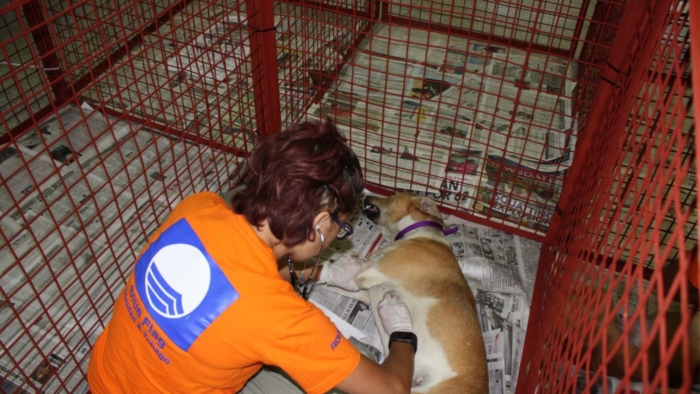
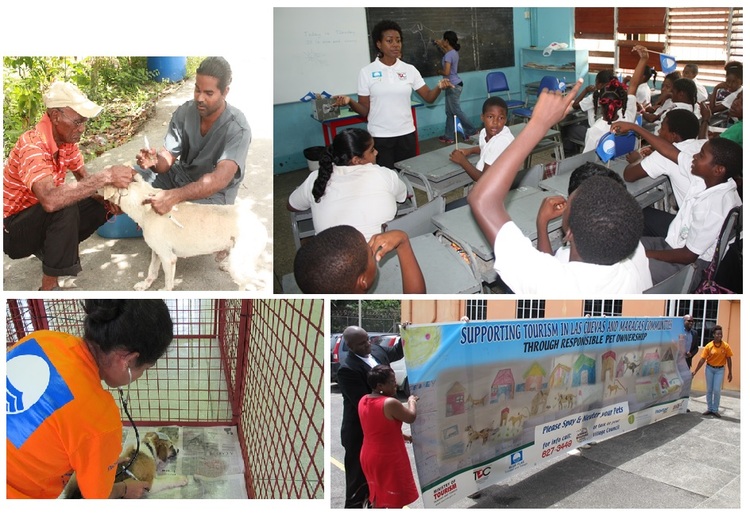
One hundred and seventy-three (173) pets belonging to residents on the North Coast of Trinidad received free veterinary treatment during the final segment of a four-part community engagement – “Humane Stray Animal Control through Spay and Neuter Intervention and Responsible Pet Ownership” programme facilitated by Asclepius Green, the National Coordinator for the Blue Flag programme, and supported by the Tourism Development Company (TDC) in May and June 2016. Asclepius Green is proud to work with the Beach Operator (TDC) as they seek to meet and maintain strict Blue Flag certification criteria including the control of the stray animal population on its Blue Flag beach.
The clinic was officially opened with a small ceremony attended by Tourism Officials, members of several animal welfare NGOs and staff and students of the Las Cuevas Government Primary School. The field veterinary clinic had a dedicated veterinary team of passionate volunteers giving over 900 hours of free work to the project. The clinic opened daily from 7:30am to 7:30pm and of the 173 animals seen, 102 were spayed/neutered.
The Responsible Pet Ownership project was one of five environmental outreach activities completed by the TDC in order to maintain the Las Cuevas beach facility’s Blue Flag status.
Other community outreach initiatives undertaken included an interactive school outreach session at the Las Cuevas Government Primary School; a community outreach event on responsible pet ownership and tourism; and a community walkabout to raise awareness, provide basic medical care to pets and pre-register pet owners for a free spay and neuter field clinic.